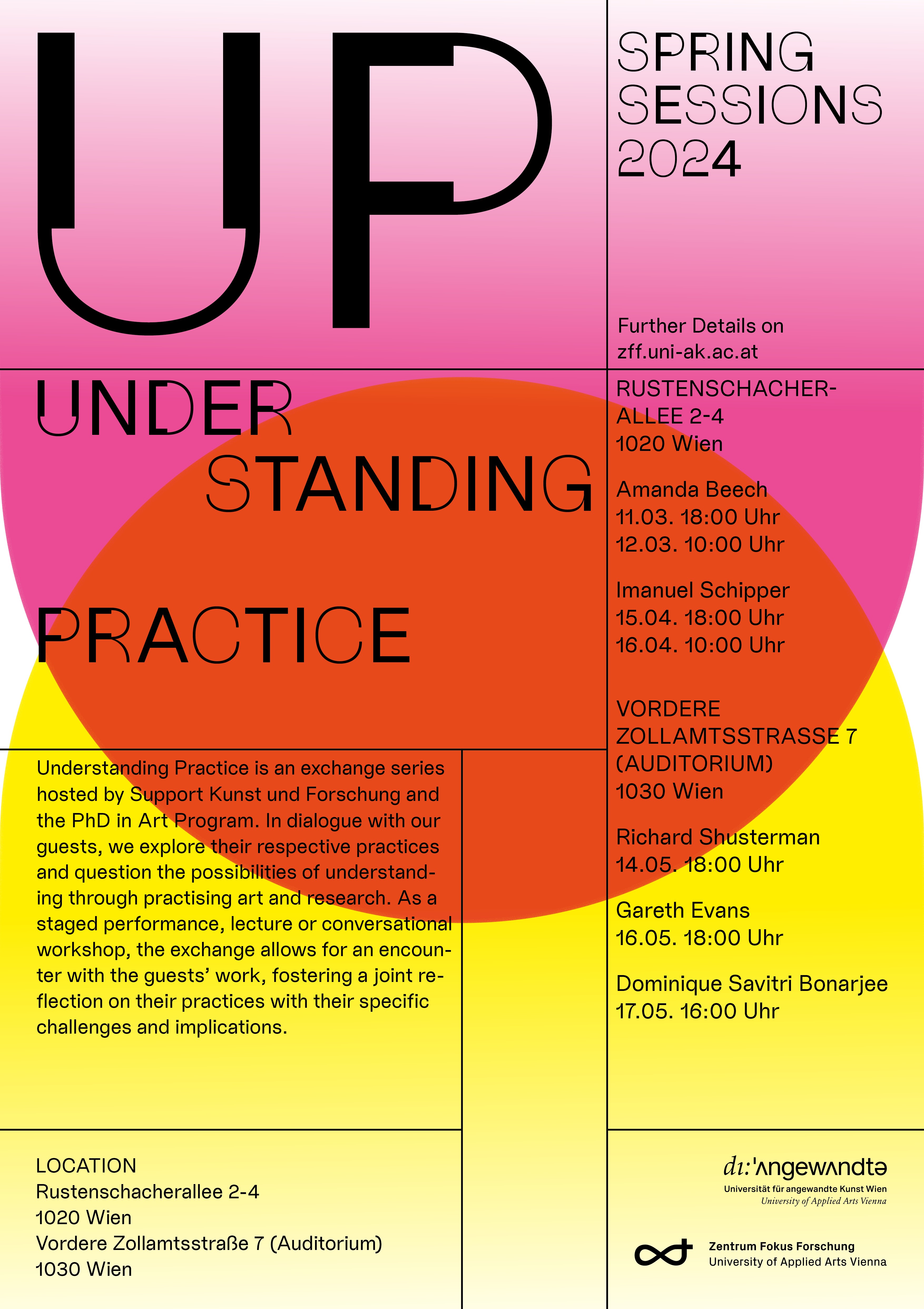
Understanding Practice
with
Richard Shusterman and Dominique Savitri Bonarjee with Jack Halberstam
Understanding Practice
Zentrum Fokus Forschung
Zentrum Fokus Forschung
Understanding
Practice is an event series hosted by the Support Art & Research and the Artistic Research PhD Programme
(PhD in Art) from the University of Applied Arts Vienna.
With our renowned guests, we explore their respective practices
and experiences, questioning the possibilities of understanding and practising art and research together. In a staged performance
or lecture and a conversational workshop and exchange format, we will dive into different art and research perspectives. This
approach allows for an encounter with the invited guests' work and a joint reflection of their practice and its specific challenges
and implications.
Long identified with practices of reading, writing,
and oral dialog, philosophy originally claimed to be something other and more than words: a critical, reflective, art of living.
While recognizing the important role that words and theories play in such a philosophical life, this lecture explores my experiments
in practicing philosophy through speechless performance art with L’homme en Or (aka the Man in Gold), who embodies the philosopher
without words.
Presenting these experiments in word and image, my talk explains how such performance work inhabits a
liminal space that blurs the boundaries between art and philosophy, art and life, self and other, intelligence and madness.
Richard Shusterman is an American pragmatist philosopher. Known for his contributions to philosophical
aesthetics and the emerging field of somaesthetics, currently, he is the Dorothy F. Schmidt Eminent Scholar in the Humanities
and Professor of Philosophy at Florida Atlantic University and Director of the Center for Body, Mind, and Culture at Florida
Atlantic University. Educated at Jerusalem and Oxford, he chaired the Temple University Philosophy Department before coming
to FAU in 2005. He has held academic appointments in Paris, Berlin, Hiroshima, Rome, Oslo, Hong Kong, and Shanghai and was
awarded senior Fulbright and NEH fellowships. His widely translated research covers many topics in the human sciences with
particular emphasis on questions of philosophy, aesthetics, culture, language, identity, and embodiment. Authored books include
T.S. Eliot and the Philosophy of Criticism (Columbia 1988), Practicing Philosophy: Pragmatism and the Philosophical Life (Routledge
1997), Performing Live (Cornell 2000), Surface and Depth (Cornell 2002), and Pragmatist Aesthetics (Blackwell 1992, 2nd ed.
Rowman & Littlefield 2000, and translated into 14 languages). His recent work in somaesthetics includes three books with
Cambridge University Press: Body Consciousness (2008), Thinking through the Body (2012), and Ars Erotica: Sex and Somaesthetics
in the Classical Arts of Love (2021), and a bilingual graphic novella, The Adventures of the Man in Gold, based on his work
in performance art.
Most recently, he authored Philosophy and the Art of Writing (Routledge, 2022).
Dominique
Savitri Bonarjee centres the body as the primary material and research interface. Through dance, physical, and vocal
experiments, Dominique seeks to untether forms from (human) cultural perceptions and experience matter’s nameless state. Performed
in different places worldwide over the last years, Dominique Collapsing is a ritual of resistance and surrender, a practice
for listening to gravity, time, the weather, the climate, and the movements of an expanded field of aliveness. For Understanding
Practice Dominique’s Collapsing will be enriched by Jack Halberstam’s response, researching collapsing as an opportunity to
imagine and create new ways of living and relating to one another.
Dominique Savitri Bonarjee
is an artist, a dancer, a seeker. Her research focuses on embodied knowing within the movement and dance practices of ancient
wisdom traditions. In her art practice she innovates unrestrictedly across media and disciplines combining sound, dance, sculpture,
electronics, textiles to imagine living artforms through which to contemplate energy, transformation, transduction, and impermanence.
Her Art PhD (Goldsmiths University) is entitled Space of the Nameless and proposes a methodology for ‘detaching the I’ to
enable polydisciplinary experimentation in the expanded field of dance. She is a qualified Tai Chi Chuan instructor, a Sufi
dervish, and a student of Hindustani Classical Music. Her monograph, Butoh, as Heard by a Dancer (Routledge,2024) is an oral
account of Butoh’s postwar Japanese origins and legacies, told from a practitioner’s perspective. In a similar vein to Marcel
Duchamp's introduction of the 'readymade' into art, in her art, she aspires to stage the human body as a radical vessel of
flux—a fountain.
Jack Halberstam is the David Feinson Professor of The Humanities at Columbia
University. Halberstam is the author of seven books including: Skin Shows: Gothic Horror and the Technology of Monsters (Duke
UP, 1995), Female Masculinity (Duke UP, 1998), In A Queer Time and Place (NYU Press, 2005), The Queer Art of Failure (Duke
UP, 2011), Gaga Feminism: Sex, Gender, and the End of Normal (Beacon Press, 2012) and, a short book titled Trans*: A Quick
and Quirky Account of Gender Variance (University of California Press). Halberstam’s latest book, 2020 from Duke UP is titled
Wild Things: The Disorder of Desire. Places Journal awarded Halberstam its Arcus/Places Prize in 2018 for innovative public
scholarship on the relationship between gender, sexuality and the built environment. Halberstam is now finishing a second
volume on wildness titled: Unworlding: An Aesthetics of Collapse. Halberstam was recently the subject of a short film titled
“So We Moved” by Adam Pendleton. Halberstam was recently named a 2024 Guggenheim Fellow.
Jack Halberstam’s contribution
is made possible with the kind support of the Department of Art History and Department of Art Theory of the University of
Applied Arts, and the Department of Gender Studies(IKM), mdw, University of Music and Performing Arts, Vienna.