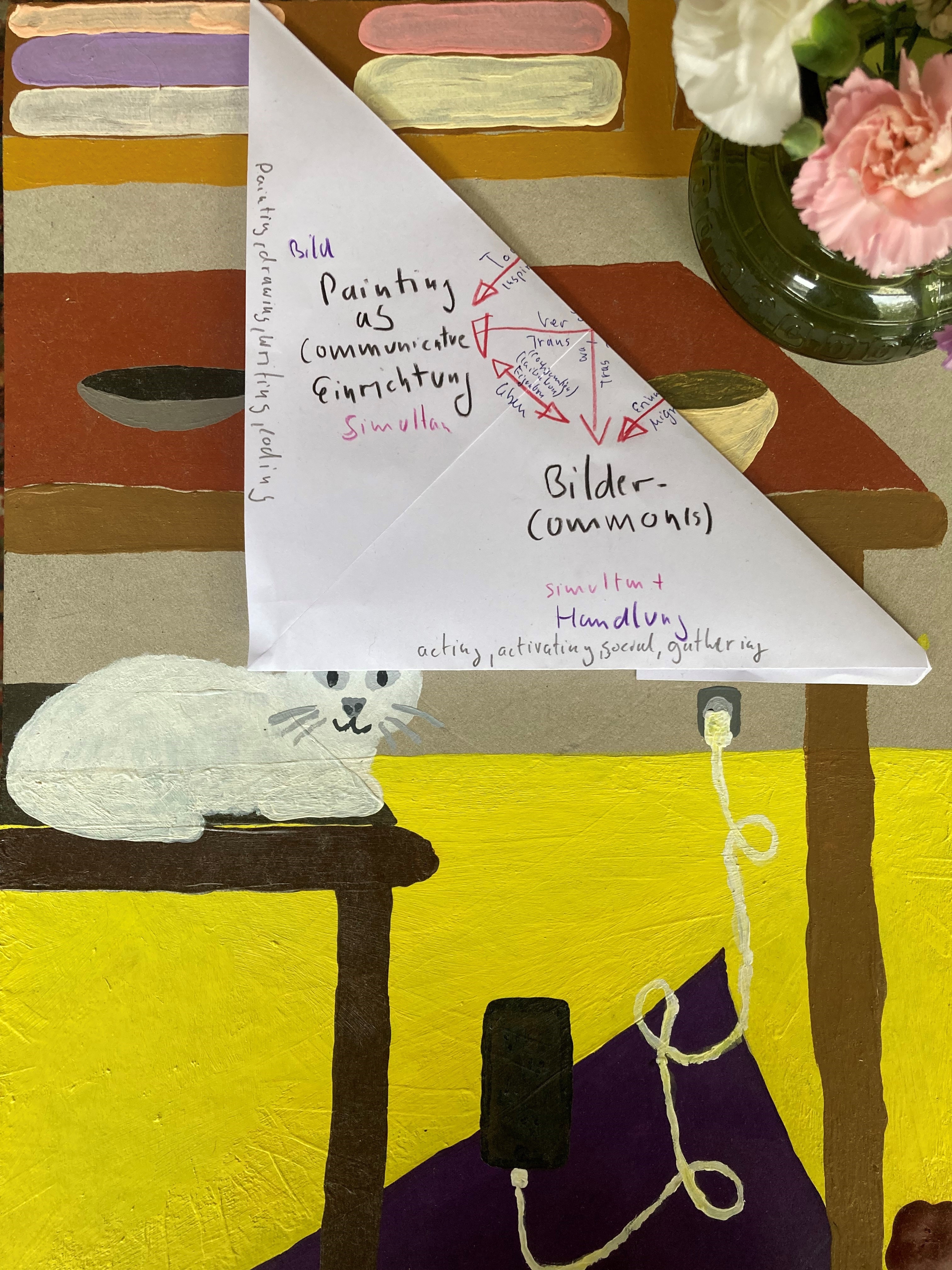
Painting as communicative Einrichtung - Bilder-Commons - Image Constellation
Panel by Philipp Schwalb
Painting as communicative Einrichtung - Bilder-Commons - Image Constellation
Panel by Philipp Schwalb
Abteilung Malerei
In
1919, 103 years ago, Florine Stettheimer embedded her own paintings in the painting Studio Party (Soirée) as furniture, as
an integral and functional element of her salon practice in New York City. These relational images supported the communication
between guests, scenes, paintings, and other images, while exposing a contemplative, cognitive, and interactive setting for
a social figuration. A few years later, the art historian and museum director Alexander Dorner commissioned
El Lissitzky’s “Abstract Cabinet,” a room with a reduced, holistic, usable, and abstract design dedicated to the relationality,
presentability, and function of images. Visitors were allowed to change the position of some of the paintings, thereby creating
new constellations and experimenting with the flexible uses, different perspectives, and changing meanings of artworks. Dorner
was explicitly interested in the social and interactive components of artworks, their relationships to each other, and to
their surroundings. In 1974 Michel Asher removed the wall dividing a gallery’s office/storage and the exhibition space. 4
years earlier Pierre Klossowski published La Monnaie vivante and developed the idea of a painting as a coin with three sides.
In Mind of My Mind (1977), Octavia E. Butler outlined the role of the artist as a telepathic medium and art as a generator
of psychedelic, emotional, and educational translations.
The
hinge between these two passages is Painting as communicative Einrichtung, as a specialized form of painting critical of institutions,
as decorative picture, and as an arrangement for different conceptual/philosophical orientations. Uff.
In 2020, 4 years ago, I embedded my own paintings in the painting Books(h)elf (Agnes Martin) as furniture, as an
integral and functional element of my exhibition, reading, and social practice in NYC. These relational images supported the
communication between peers, influences, paintings, and other images, while integrating a contemplative, emotional, and physical
setting for a social figuration. A few years later, I made the exhibition “Die Gift Born” as a display dedicated to a reduced,
associative, usable, and abstract narrative that exposes the relationality, presentability, and the function of images. Most
of the images were carefully treated and visible from two sides. Visitors were allowed to change the position of the paintings,
to create new constellations, and to experiment with the flexible uses, different perspectives, and changing meanings of artworks.
I was interested in the social and interactive components of the paintings, their relationships to each other, and to their
surroundings. This Image Constellation Panel (ICP) is located in the passage between studio and public, between practice and
theory, between aesthetics and anti-aesthetics, and is an instrument between exhibition, lecture, mind-map, and discursive
assembly. The ICP on May 13 2024 is about my methods, my paintings, four exhibitions, adjectives that describe different ways
of translation (into painting), Painting as communicative Einrichtung, and Bilder-Commons.
Philipp
Schwalb lives and works in Rotterdam as an artist, reader, curator, and art educator. Since 2010 he has been experimenting
with and questioning the animation of color and figuration in Bilder, their communication, conditions, effects, and frameworks.
Since 2008 he has been involved in several self-organized spaces, exhibitions, labs, sessions, and conventions. In 2018/19
he organized the Geneva “Convention of more Sense in Leif + Lof 4 ALLe.” From 2017 to 2019, he was a visiting professor for
painting at the Haute Ecole d'art et Design in Geneva. In 2022 he co-organized and curated the “Mural Sessions” in Geneva.
In 2022, he launched Bild as Commons. In 2023 he co-organized I/Economic Sediments, a series of workshops for the collective
creation of image constellation panels. He has exhibited or curated at the following venues: Kirchgasse (Steckborn), New Toni
(Berlin), Le Frac Lorraine, Kunsthalle Langenthal, Kunsthalle Marcel Duchamp (Cully), Kunsthalle Basel, ZKM Karlsruhe, Kunstraum
München, Villa Romana (Florence), David Castillo (Miami).