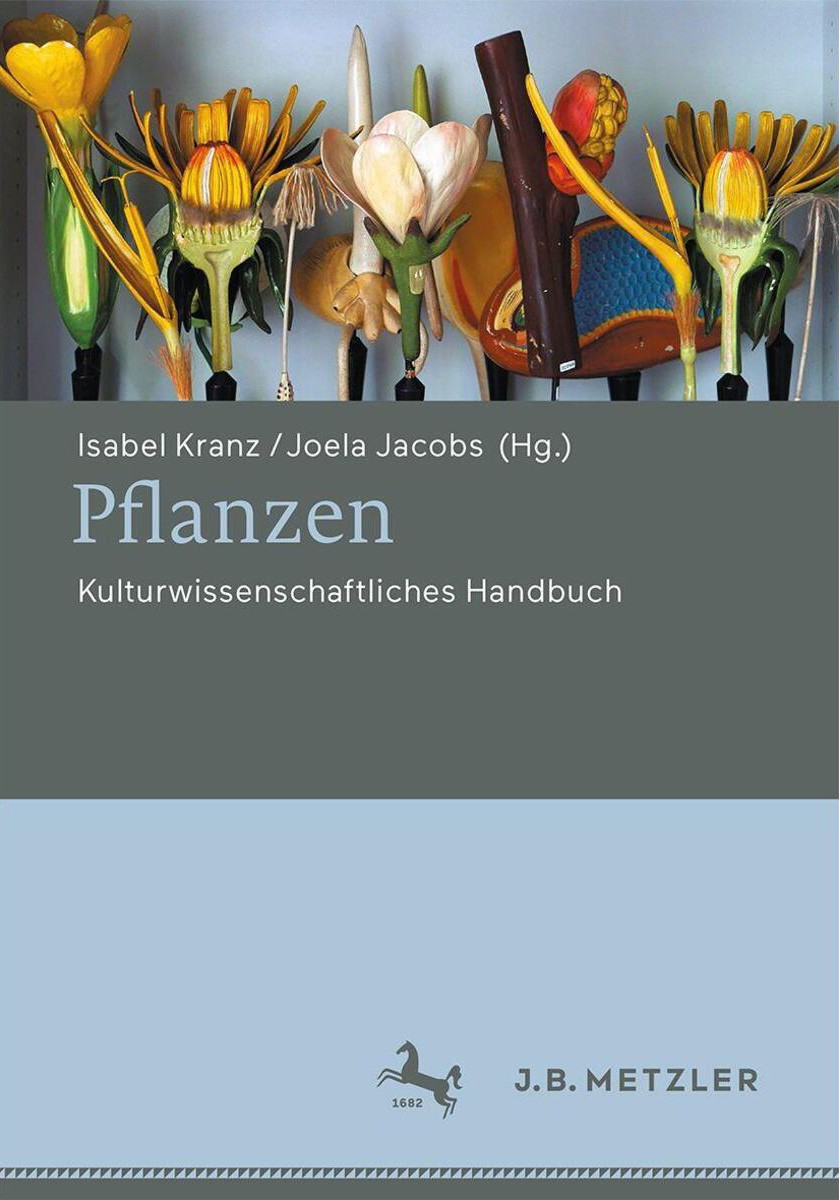
An event with Helga G. Braunbeck, Joela Jacobs, Johannes
Wankhammer and Isabel Kranz, Head of the Department of Cultural Studies at the University of Applied
Arts Vienna.
This webinar introduces a newly published cultural studies companion to plants
(Pflanzen: Kulturwissenschaftliches Handbuch, Metzler, 2026) that examines the role of the vegetal world in the construction
of culture. The chapters consider plants both as living organisms and in terms of their symbolic and metaphorical significance
—across literature, art, religion, and cultural history. Featuring the two editors and two authors, the webinar will introduce
the book generally and then dive into the entries on leaves and roots. The speakers will discuss how plants have been shaping
human culture for centuries and why plants have come to the forefront of cultural debates today.
This event is organised by the Brandeis University, Center for German and European Studies.
Helga G. Braunbeck is Professor Emerita of German Studies
at North Carolina State University, where she has also served as Assistant Dean for Interdisciplinary Studies. Her two books
analyze issues of intertextuality and intermediality but her current research is situated in the environmental humanities,
with a focus on literary and cultural plant studies. Her articles and book chapters discuss representations of moss, gardening,
lignite mining, smart cities, lichen, third nature, the leaf, hunting and gender, and hunting and forest ecology. She co-wrote
the editorial for a Green Letters special issue on “Arboreal Imaginaries." And she is currently co-editing and writing commentary
for the literary works of German/Czech author Libuše Moníková, on behalf of the German Academy for Language and Literature.
Joela
Jacobs is Associate Professor of German Studies at the University of Arizona, and she founded and maintains the Literary
and Cultural Plant Studies Network. Her research focuses on the intersection of 19th-21st century German literature with Plant
and Animal Studies, Environmental Humanities, Jewish Studies as well as the Histories of Sexuality and of Science. Recent
books include the monograph Animal, Vegetal, Marginal: The German Literary Grotesque from Panizza to Kafka, a volume on Plant
Poetics, and a cultural mini-history of small matter from animalcules to viruses, called Microbium. She is the editor of the
journal Plant Perspectives
Isabel Kranz is Professor of Cultural Studies at the
University of Applied Arts in Vienna, Austria. A literary scholar by training, Isabel’s research ranges from the so-called
‘Erste Kulturwissenschaft’ to imaginations of the future and Critical Plant Studies. Isabel co-founded the Literary and Cultural
Plant Studies Network and is a Principal Investigator of the research group Phytological Critique. Her publications include
Sprechende Blumen: Ein ABC der Pflanzensprache (2014), Plant Poetics: Forms and Functions of the Vegetal (co-ed. with Joela
Jacobs and Solvejg Nitzke) as well as Pflanzen: Kulturwissenschaftliches Handbuch (2026). Currently, Isabel Kranz is working
on a book manuscript about flowers as figures of knowledge. (https://base.uni-ak.ac.at/showroom/isabel-kranz-h3oH)
Johannes
Wankhammer is Associate Professor of German at Princeton University. His research focuses on eighteenth-century aesthetics,
the cultural history of attention, and the environmental humanities, with particular interests in the metaphorology of plant
life and the conceptual history of ecological thought. His first book, Creatures of Attention: Aesthetics and the Subject
before Kant (Cornell University Press, 2024), traces the entwined histories of attention and aesthetics in the long eighteenth
century. Publications in the environmental humanities include articles on anthropomorphism in Peter Wohlleben’s writing about
trees and on narrative experiments with more-than-human worlds in Max Frisch’s Der Mensch erscheint im Holozän.
Information
on the publication
Isabel Kranz / Joela Jacobs (Hrsg.): Pflanzen: Kulturwissenschaftliches Handbuch
Stuttgart:
J. B. Metzler 2026, ISBN: 978-3-476-06021-1